The history of St Mark's Campanile
More than a thousand years in a single tower: lighthouse for sailors, clock of the Serenissima, symbol of Venice. And then the collapse of 1902 and a promise kept: "as it was, where it was".
ⓘ Unofficial site — read the disclaimerA lighthouse born from the water (9th–10th century)
The history of the Campanile begins with a practical problem: how to navigate a flat, fog-prone lagoon. Around 888 AD, under Doge Pietro Tribuno, Venice began construction of a watchtower on foundations said to rest on the remains of ancient Roman structures. It was to serve as a landmark for those arriving from the sea and as a lookout for the city.
Work continued over the centuries, as was typical of great medieval building projects. The foundations were completed in the early decades of the 10th century, but the tower took shape slowly, one building campaign at a time, doge after doge.
From watchtower to bell tower (12th century)
By the mid-12th century the tower had been raised to around 60 metres under Doge Domenico Morosini. Shortly after, between 1156 and 1172, the belfry and upper section were added, attributed to master craftsmen led by Niccolò Barattieri — the same engineer associated with the celebrated columns of the Piazzetta di San Marco.
From that moment the tower was no longer merely a lighthouse: it became the Basilica's bell tower and, in effect, the Republic's sonic clock. Its bells governed the day for everyone, from senators to craftsmen.
The Renaissance face and the angel (16th century)
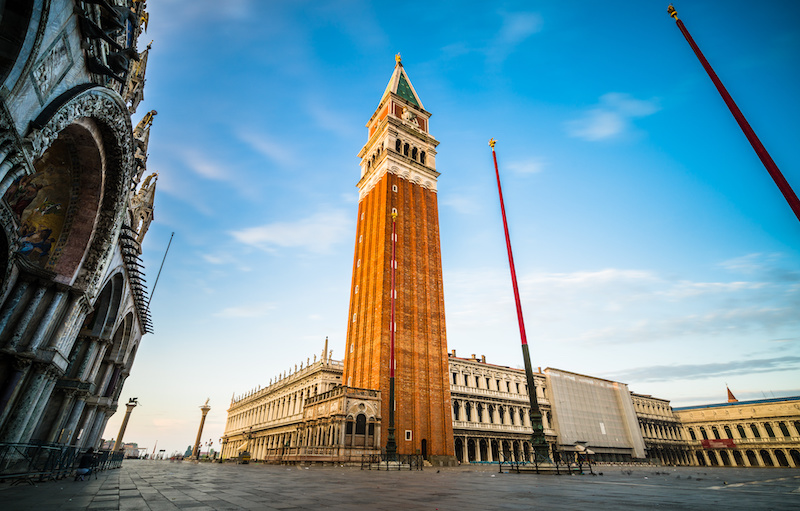
At the start of the sixteenth century the Campanile acquired the appearance we know today. After damage from lightning strikes and earthquakes, the summit was remodelled with the white stone belfry, the decorated attic storey and the pyramidal spire. In 1513 the gilded statue of the Archangel Gabriel was placed at the very top, turning freely in the wind.
At the base of the tower, between 1538 and 1546, Jacopo Sansovino created the exquisite Loggetta in marble — a small Renaissance jewel that served as a gathering place for the Venetian nobility. In 1776 the tower was fitted with a lightning conductor, among the first in Italy, to protect it from the bolts that had already struck it several times.
14 July 1902: the collapse
On the morning of 14 July 1902, after days of alarming cracks had been observed, the Campanile collapsed in on itself. It was an almost "courteous" fall: the tower folded into a heap of bricks without bringing down the Basilica, which suffered only minor damage. Most remarkably, no people were killed. The only casualty, according to contemporary accounts, was the custodian's cat.
The Marangona, the great bell, also survived intact among the rubble. Sansovino's Loggetta, crushed by the collapse, was painstakingly reassembled piece by piece.
"As it was, where it was": the reconstruction
That very evening the city council resolved to rebuild the Campanile "as it was, where it was" — in the same location and with the same appearance. It was a declaration of love for a symbol, but also a bold technical choice.
The new tower was built to modern standards — reinforced foundations, a lightened internal structure — but faithful to the Renaissance form. The work took ten years. The Campanile was reborn and inaugurated on 25 April 1912, the feast day of St Mark, exactly one thousand years after the laying of the original foundations.
Key dates
| Year | Event |
|---|---|
| ~888 | Construction of the watchtower begins under Doge Pietro Tribuno. |
| 10th century | Completion of the foundations. |
| 1148–1156 | The tower reaches approximately 60 metres. |
| 1156–1172 | Construction of the belfry (Niccolò Barattieri). |
| 1513 | The gilded statue of the Archangel Gabriel is placed at the top. |
| 1538–1546 | Sansovino builds the Loggetta at the base. |
| 1776 | Lightning conductor installed. |
| 14 July 1902 | The Campanile collapses — no human casualties. |
| 25 April 1912 | The rebuilt tower is inaugurated. |
| 1932 | The lift is installed. |
The Campanile today
Since 1912 the tower has dominated the Piazza once again, identical in appearance but stronger at its core. The lift installed in 1932 made it accessible to all, transforming it from a bell tower into a mass viewpoint. Today it is one of the most visited places in Venice and, for many, the first stop for understanding the city's geography.
Knowing its history changes the experience of the climb: when you reach the top and see the Marangona, you know that bell rang for the Republic, survived a collapse and returned to its place. For the tower's dimensions and structure, see the height and facts page; to plan your visit, check opening hours and prices.
"I always tell the story of the 1902 collapse before anyone goes up. Knowing that the tower you're about to climb is a faithful reconstruction — not the original millennium-old building — makes the experience more powerful, not less."
History: common queries
When did the Campanile collapse?
Is the Campanile today the original?
Why did it collapse?
Who built the Loggetta at the base?
Climb the tower Venice rebuilt twice
Visit the Campanile, see the Marangona and take in the view from the heights of Venetian history.
Check availability and prices